 How-to
What Drives Commercial Cleaning Service Pricing?
Last Updated: October 28, 2026
Quick Summary
Commercial cleaning pricing depends on cleanable square footage, cleaning frequency, labor hours per visit, building type and the exact scope of work. Pricing models include per square foot, hourly, per visit and monthly contracts. Compare bids by normalizing them to the same square footage, visit frequency and labor hours.
- Measure cleanable square footage, not lease area, and confirm each bid uses the same basis.
- Cleaning frequency changes total cost more than most buyers expect, so price each frequency option.
- Ask every provider for labor hours per visit, since it is the best predictor of a realistic scope.
- Check whether restroom sanitizing, trash removal and floor care are included before comparing totals.
- Watch for escalation clauses and setup or minimum charges that can make a low first-year rate costlier.
Table of Contents
- How Commercial Cleaning Companies Build a Price
- Facility Size and Cleanable Square Footage
- Commercial Cleaning Cost Per Square Foot Explained
- Office Cleaning Frequency and Cost
- Building Type, Scope of Work, and Operational Factors
- Commercial Cleaning Cost Estimate Example
- Commercial Cleaning Quote Checklist for Apples-to-Apples Comparisons
- Scheduling Your Walkthrough to Get an Accurate Quote
- Frequently Asked Questions
Commercial cleaning service pricing is rarely a single number, which is why two quotes for the same building can differ by hundreds of dollars. The price reflects how much time, labor, supplies and equipment a facility needs, how often, and how much risk the cleaning company takes on. Understanding those drivers lets you read a quote the way a facility manager should, not just compare bottom lines.
This guide explains how cleaning companies arrive at a price, which factors move it, and how to compare bids apples-to-apples. Commercial cleaning pricing is not a mystery, but it requires asking the right questions.
How Commercial Cleaning Companies Build a Price
Commercial cleaning pricing starts with the scope of work. A provider estimates the labor hours needed to clean the space to your standard, then adds supplies, equipment, supervision and overhead, and often a margin.
Pricing models generally fall into a few categories:
- Per square foot: The total price is calculated from the cleanable area. This is common for offices and larger buildings.
- Hourly: The price is based on the labor hours required, often used for smaller jobs or one-time projects.
- Per visit: A fixed fee for each cleaning, typically used when the schedule and scope are well defined.
- Monthly contract: A recurring fee tied to a set schedule and agreed scope of work.
Each model has trade-offs: a square-foot rate is easy to compare but can hide scope differences, while an hourly rate can look low while total hours climb.
Facility Size and Cleanable Square Footage
Facility size is the most visible pricing driver, but the number that matters is cleanable square footage, not lease area. Closets, mechanical rooms and areas never cleaned may not belong in the calculation.
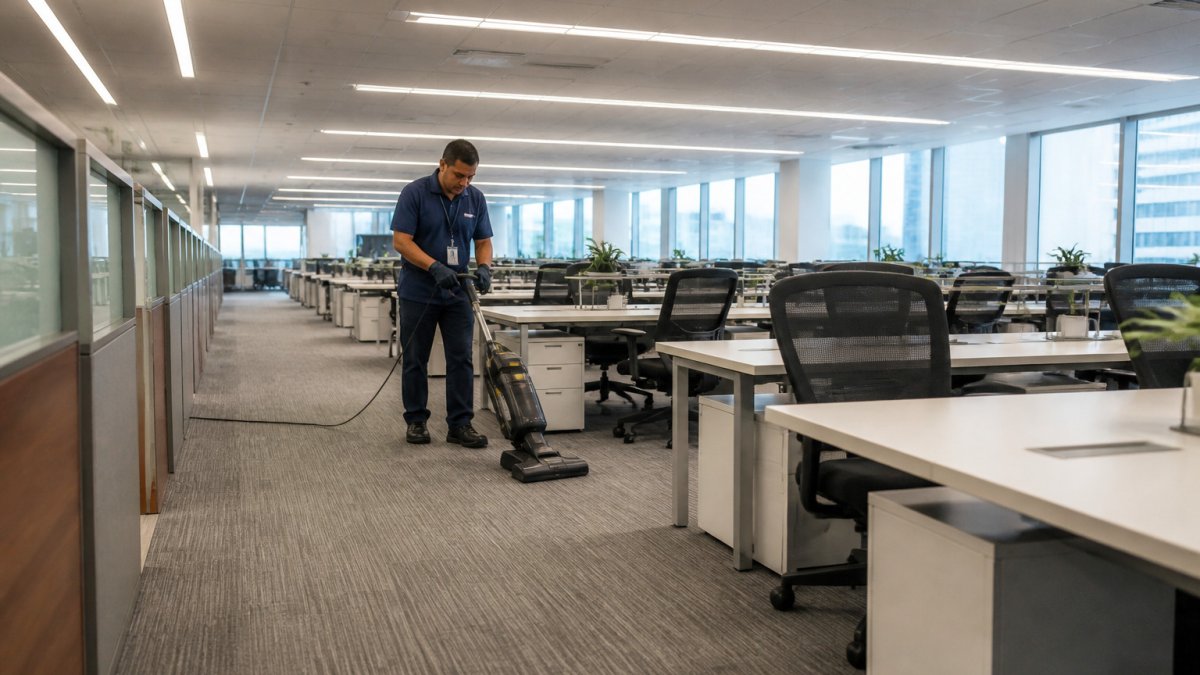
Larger spaces require more time, supplies and often more crew, but the relationship is not always linear. Some providers reduce the per-square-foot rate for very large buildings, while small spaces carry a higher effective rate because travel and setup spread across fewer square feet.
Commercial Cleaning Cost Per Square Foot Explained
Cost per square foot is a useful benchmark but needs context: a few cents per square foot for light office cleaning will not describe a restroom-heavy clinic or manufacturing floor.
Published industry guides show a wide per-square-foot range that differs by source and year, so treat any range as a starting point. Before comparing bids, convert every quote to the same basis, such as monthly total divided by cleanable square footage.
Office Cleaning Frequency and Cost
Frequency changes cost more than most buyers expect. Nightly cleaning requires more total labor hours than weekly service, but the per-visit cost may be lower because the crew works a regular routine. Deep cleaning adds specialized tasks priced separately.
Match frequency to actual use: high-traffic offices often need daily service for restrooms and common areas, while lighter-occupancy offices may do well with a few visits per week plus a monthly deep clean. You can review our office cleaning service options to see how visit frequency is structured.
Building Type, Scope of Work, and Operational Factors
Building type shapes the work: clinics, schools, retail spaces and industrial facilities each carry different sanitation, floor care and documentation requirements. A clinic may need stricter disinfection protocols, while a warehouse may need floor stripping and heavy-duty degreasing.
Operational factors also affect price:
- Access and timing: Cleaning during business hours costs differently than overnight work.
- Foot traffic and occupancy: Heavily used spaces need more frequent service.
- Specialized services: Carpet extraction, floor finishing and window cleaning are often priced as add-ons.
- Supplies and equipment: Who provides supplies, and what quality standards they must meet, changes the total.
Watch out: a quote that omits restroom sanitizing, trash removal or floor care may look cheaper only because those tasks are excluded. Confirm the scope line by line.
Commercial Cleaning Cost Estimate Example
A worked example is more useful than a range, because it shows how square footage, labor hours, frequency, supplies and overhead combine into a monthly number, and lets you sanity-check any bid.
Below is a transparent estimating worksheet. The dollar figures are illustrative placeholders, not market rates; substitute your own local labor and supply costs. The structure is what matters.
Step 1: Establish cleanable square footage
Start with the area that is actually serviced, not the lease square footage. Exclude mechanical rooms, locked storage and unfinished space. For this example, assume 10,000 cleanable square feet in a multi-tenant office.
Step 2: Estimate labor hours per visit
Labor is the largest line in almost every commercial cleaning quote. A common method assigns a production rate, square feet cleaned per labor hour, by area type, then adds time for task-heavy spaces.
| Area type | Cleanable sq ft | Production rate (sq ft per labor hour) | Labor hours per visit |
|---|---|---|---|
| General office | 8,000 | 3,000-4,000 | 2.0-2.7 |
| Restrooms (task-based) | 1,200 | 1,500-2,000 | 0.6-0.8 |
| Break room / kitchenette | 800 | 1,500-2,000 | 0.4-0.5 |
| Total | 10,000 | , | 3.0-4.0 |
Providers then add non-cleaning time, setup, restocking, security check-in and lock-up, commonly 15-25% on top of cleaning hours. At 3.5 cleaning hours plus 20% support time, plan on roughly 4.2 labor hours per visit.
Step 3: Convert frequency into monthly hours
Five visits per week is about 21.7 visits per month (52 weeks × 5 ÷ 12). At 4.2 hours per visit, that is roughly 91 labor hours per month.
Step 4: Apply a fully burdened labor rate
The hourly rate in a quote is not the cleaner's wage; it includes payroll taxes, workers' compensation, paid time off, supervision and training. A common burden multiplier is 1.25-1.45 on the base wage, plus a supervision allocation. At a $16 base wage and 1.35 multiplier, the loaded rate is about $21.60 per hour before supervision and margin.
Step 5: Add supplies, equipment and overhead
| Line item | Basis | Illustrative monthly amount |
|---|---|---|
| Labor (91 hours × $21.60 loaded rate) | Hours × loaded rate | $1,966 |
| Supplies (consumables, liners, chemicals) | Per cleanable sq ft or per visit | $180-$320 |
| Equipment (machines, tools, wear) | Allocation | $60-$120 |
| Supervision and administration | 8-15% of labor | $157-$295 |
| Insurance and compliance | Allocation | $40-$90 |
| Subtotal (cost) | , | $2,403-$2,791 |
| Margin | 10-20% of subtotal | $240-$558 |
| Monthly quote | , | $2,643-$3,349 |
Divide the monthly quote by 10,000 cleanable square feet to get a per-square-foot-per-month figure, in this example, roughly $0.26 to $0.33 per square foot per month. That is the number to compare across bids, not the headline monthly total.
Step 6: Stress-test the number
Run the worksheet at three visits per week and at six nights per week to see how the monthly total moves, then compare that to the provider's quoted options. If price does not scale roughly with hours, ask why: minimum charges, trip fees or bundled add-ons may be embedded.
This worksheet is a planning tool, not a bid. Use it to ask better questions during the walkthrough and spot assumptions that do not match your building.
Commercial Cleaning Quote Checklist for Apples-to-Apples Comparisons
This section gives you a scope-normalization method and a set of red flags that separate a genuinely competitive bid from one that is cheap because it is incomplete.
Normalize every bid to the same basis
Before comparing totals, convert each quote to three common denominators:
- Monthly cost per cleanable square foot, monthly total ÷ cleanable square footage.
- Labor hours per visit, ask for this explicitly; it is the single best predictor of whether the scope is realistic.
- Cost per visit, monthly total ÷ visits per month.
If a provider will not disclose labor hours, that is itself a data point; most established cleaners can give an hours-per-visit estimate without revealing wage rates.
The scope audit checklist
Use this list against every bid, side by side:
- Cleanable square footage, same measurement basis for every bid, with excluded areas named.
- Frequency and visit windows, same number of visits per week, same days, same after-hours or daytime window.
- Restroom count and fixture count, restrooms are task-driven, not square-footage-driven; a bid that ignores fixture count is guessing.
- Trash and recycling, removal, liner replacement and haul-away responsibility stated.
Red flags that explain an unusually low bid
When one bid is far below the others, the gap is almost always explained by one of these mechanisms:
- Scope exclusion. Restroom sanitizing, floor care or trash haul-away is priced separately or omitted. The low bid is low because it is a smaller job.
- Frequency mismatch. The bid assumes three visits per week while the others assume five. Normalize to cost per visit before comparing.
- Labor-hour shortfall. The provider plans fewer hours than the production rates in the worksheet above can support. The crew will either cut corners or fall behind.
- Wage-tier assumptions. A bid built on a lower wage tier may not meet the building's background-check, uniform or training requirements.
Questions to ask before you sign
- How many labor hours per visit does this quote assume, and what production rates did you use?
- Which tasks are excluded, and what would they cost to add?
- What is the annual escalation, and is it capped?
- How is quality measured, and what happens if a task is missed?
- Who supplies consumables, and what happens if we run out mid-month?
A provider that answers these clearly gives you a quote you can evaluate; one that deflects is telling you something too.
Scheduling Your Walkthrough to Get an Accurate Quote
A walkthrough is the most reliable way to reduce pricing uncertainty: the provider can measure cleanable areas, identify high-traffic zones, note floor types and confirm access requirements. You can request a custom commercial cleaning quote and arrange your walkthrough directly through our contact page.
You can review our commercial cleaning pricing details. For an overview of the service itself, see our commercial cleaning services.
Frequently Asked Questions
What factors affect commercial cleaning service pricing?
The main factors are facility size measured in cleanable square feet, how often service is needed, the type of building and its traffic level, and the scope of work, including restrooms, floor care, and add-on tasks. Labor hours and supplies may vary with these inputs. Ask each provider to list the assumptions behind its quote so you can see which factor is driving the difference between bids.
How do commercial cleaning companies calculate their prices?
Most providers estimate the labor hours a visit requires, multiply by an hourly labor rate, and add supplies, equipment, overhead, and profit. Some also quote a flat per-square-foot or per-visit price for predictable scopes. The method matters less than whether the estimate reflects the actual tasks and frequency you need. A transparent quote shows the hours and the scope it covers so you can check its logic against your own building.
How can a business compare commercial cleaning quotes fairly?
Start by making sure every bid covers the same scope, frequency, and areas, such as restrooms, break rooms, floors, and trash removal. Confirm whether supplies and equipment are included and what the contract term requires. Once the scope is identical, compare the total monthly and annual cost rather than the lowest per-square-foot figure. A quote that looks cheaper may leave out tasks you would otherwise have to pay for separately.