 Comparison
Which Eco-Friendly Disinfectants Work in Clinics?
Last Updated: November 1, 2026
Quick Summary
The best eco friendly disinfectants for clinics are products with a current EPA registration that carries kill claims for the organisms and surfaces your facility needs. A plant-based label alone does not confirm disinfecting power. Check the label's organism list, contact time, and surface approvals before choosing.
- Confirm an EPA registration number and read the full label PDF from the manufacturer.
- Verify the product carries disinfectant claims, not just sanitizer claims, for clinical use.
- Match each product's organism list to room risk, especially for norovirus and Candida auris.
- Follow the label's contact time exactly, since wiping too early leaves pathogens alive.
- Compare cost per room per day, including labor minutes, rather than bottle price alone.
Table of Contents
- Why Clinical Environments Demand More Than a Green Label
- How to Read an EPA Registration and Kill Claim
- Checking Pathogen Claims: Bacteria, Viruses, and Fungi
- Disinfectant Contact Time for Clinical Surfaces
- Comparing Plant-Based, Citric Acid, Hydrogen Peroxide, and Quat Options
- Material Compatibility, Cost per Use, and Staff Safety
- Healthcare Environmental Cleaning Best Practices and Your Next Step
- Frequently Asked Questions
Why Clinical Environments Demand More Than a Green Label
Choosing the best eco friendly disinfectants for clinical environments starts with a simple question: will the product kill what needs killing? To compare the cost of an outsourced program, review transparent cleaning pricing.
Clinical settings carry a higher infection-control burden than offices or retail spaces. Exam tables, bed rails, faucet handles and call buttons are touched constantly by patients and staff.
The practical standard is this: an eco-friendly product earns a place in a clinic only after it proves it kills the target organisms on the surfaces where it will be used.
How to Read an EPA Registration and Kill Claim
Every disinfectant sold in the United States for hard-surface use should carry an EPA registration number on its label (the EPA). Environmental Protection Agency (EPA Disinfectants Registration Information) regulates these products and approves the specific claims printed on them.
Read the label, not the marketing. A registered product lists the organisms it kills and the surfaces it is approved for. Terms like "natural," "green" or "non-toxic" are not regulatory claims and do not indicate disinfecting power.
Pay close attention to whether the label is a disinfectant claim or a sanitizer claim. Sanitizers reduce bacteria to safe levels; disinfectants are designed to kill a broader range of pathogens.
Checking Pathogen Claims: Bacteria, Viruses, and Fungi
A disinfectant label is a legal document, and the organism list on it is the product's actual scope of efficacy. In a clinical setting, that phrase is useless. What matters is which organisms the product is registered against, on which surfaces, and under which test method.
The three organism classes and why each matters clinically
- Bacteria. Vegetative bacteria such as Staphylococcus aureus, Pseudomonas aeruginosa, Escherichia coli, and Enterococcus species are the baseline hospital-grade claims. Many products also carry claims against Salmonella and Listeria for food-contact areas. A product with only a sanitizer claim (typically a 99.9% reduction in 30 seconds on a pre-cleaned surface) is not the same as a disinfectant claim, which is a kill claim against named organisms at a stated contact time.
- Viruses. Enveloped viruses (for example, influenza and coronaviruses) are generally easier to kill than non-enveloped viruses such as norovirus, rotavirus, and poliovirus. A product may be labeled against enveloped viruses only. In waiting rooms, restrooms, and any area where vomiting or diarrheal illness has occurred, non-enveloped virus claims matter. Check the label's organism list, not the front panel.
- Fungi and mycobacteria. Candida auris is a current concern in healthcare because it survives on surfaces and resists some common actives (the CDC). Mycobacterium claims (often tested as Mycobacterium bovis BCG) are a stricter benchmark and are frequently absent from lighter-duty eco-products. If your facility serves immunocompromised patients, fungal and mycobacterial claims should be on your checklist.
The test standards behind the claims
The EPA does not accept a manufacturer's word. Disinfectant claims are supported by standardized laboratory methods, and the label's efficacy data are reviewed against those methods. The commonly referenced families are:
- AOAC use-dilution and carrier tests for hard-surface disinfectants.
- ASTM standard practices for evaluating disinfectants on non-porous surfaces.
- OECD and EPA harmonized methods for certain virucidal and fungicidal claims.
You do not need to memorize the method numbers. You do need to know that a claim is tied to a specific test organism, a specific soil load (clean vs. dirty conditions), and a specific contact time. A product tested under clean conditions may not carry a claim for visibly soiled surfaces.
How to map claims to rooms
A practical approach is to build a simple matrix before you buy:
- List your room types, waiting area, exam room, procedure room, restroom, break room, equipment staging.
- List the organisms of concern for each room based on your infection-control risk assessment.
- Match each product's label organism list to those rooms.
- Flag any room where the eco-product's label does not cover the target organism, and reserve a broader-spectrum product for that room.
This is where most green cleaning programs fail: a single plant-based product is applied everywhere, and the rooms with the highest risk get the same coverage as a lobby. Matching product to room is the single highest-value step in an eco-friendly clinical program.
What to ask a vendor
Ask for the EPA registration number, the full label PDF, and the organism list with contact times. Ask whether the product has claims under clean or dirty conditions. Ask whether the claims cover the specific surfaces in your facility. A vendor who cannot produce the label PDF is not a clinical supplier.
Disinfectant Contact Time for Clinical Surfaces
Contact time is the period a disinfectant must stay wet on a surface to kill the listed organisms. You can browse the eco-friendly cleaning products and tools used in professional workplaces.
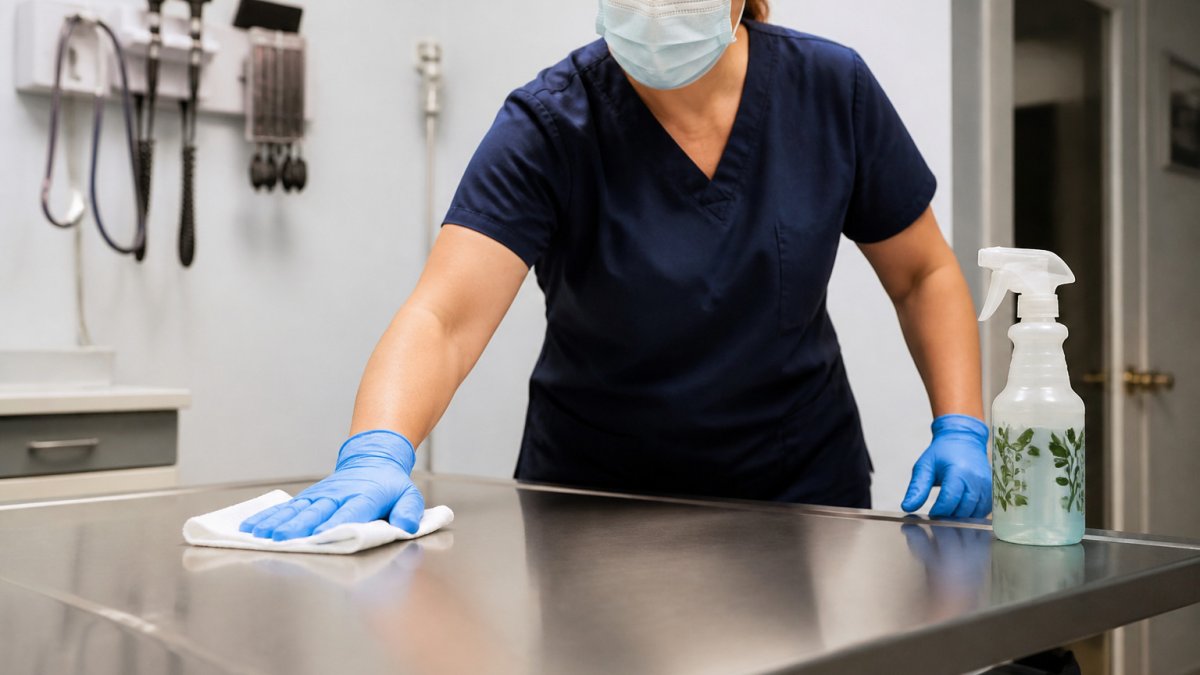
Follow the label directions exactly. If the label says 10 minutes of contact time, a surface that dries in 2 minutes has not been disinfected.
Build contact time into the cleaning schedule rather than hoping staff will remember it.
Comparing Plant-Based, Citric Acid, Hydrogen Peroxide, and Quat Options
Each active ingredient family behaves differently in clinical use:
- Plant-based and essential oil products: Often lowest in toxicity and pleasant to use, but frequently have limited EPA kill claims. Verify the registration before relying on them for disinfection.
- Citric acid products: Effective against some organisms and gentle on staff, though claims vary widely by formulation and often do not cover the full range needed in clinics.
- Hydrogen peroxide products: Broad-spectrum options with good material compatibility in many cases. Contact times and surface compatibility should be checked on each label.
Balance the environmental goal against the infection-control standard.
Watch out: A product labeled "EPA-approved" often means the manufacturer registered the product, not that it is approved for every clinical surface. Confirm the specific surface and organism claims.
The four active-ingredient families differ in how well they fit clinical use, as summarised below.
| Option | Best for | Key difference |
|---|---|---|
| Plant-based and essential oil | Low-toxicity general use | Often limited EPA kill claims; verify registration |
| Citric acid | Gentle daily cleaning | Claims vary widely; often not full clinical range |
| Hydrogen peroxide | Broad-spectrum surfaces | Check contact time and surface compatibility on label |
| Quaternary ammonium (QUATs) | Established healthcare use | Strong claims, but not plant-based |
Material Compatibility, Cost per Use, and Staff Safety
Efficacy and environmental profile get the attention, but in daily clinical operations the two questions that decide whether a product stays in the program are: does it damage the equipment, and what does it actually cost per disinfected surface? Both are routinely under-covered in green cleaning content.
Material compatibility by surface class
Repeated exposure to any disinfectant is a stress test. The label's compatibility statements and the manufacturer's technical data sheet are the starting point, but the practical concerns cluster by material:
- Stainless steel and other metals. Chlorine-based products are the classic pitting and corrosion risk; some quaternary ammonium blends can leave films or contribute to stress cracking in certain plastics. Hydrogen peroxide products are generally considered compatible with many metals at label dilution, but check the technical data sheet for your specific alloy and finish.
- Plastics and device housings. ABS, polycarbonate, and acrylic housings on monitors, keyboards, and bedside equipment can craze or cloud with repeated solvent exposure. Many wipes are labeled for a specific number of applications per day; exceeding that count is a common cause of surface damage.
- Upholstery and soft surfaces. Most disinfectants are labeled for hard, non-porous surfaces only. Curtains, chairs, and privacy drapes typically require a different product category. Do not assume a hard-surface disinfectant is approved for fabric.
A simple control is to keep a compatibility log by equipment type and review it whenever a product changes. Most damage shows up as cumulative dulling or hazing rather than a single failure, so a visual check at 30 and 90 days catches problems early.
Cost per use, not price per bottle
The sticker price is the least useful number. What matters is cost per disinfected surface, and that depends on dilution, coverage, contact time, and labor.
- Dilution. A concentrate diluted at 1:64 uses far less product per quart than a ready-to-use bottle, but only if staff measure correctly. Over-dilution weakens efficacy; under-dilution wastes product and can leave residue. Closed-loop dispensing systems reduce both errors.
- Coverage. A product that wets surfaces well at a given volume covers more square footage per bottle. A thick, foamy product may feel effective but require more product per surface.
- Contact time and labor. A 10-minute contact time on a high-touch surface means either a second pass or a longer dwell, both of which consume staff minutes. A 1-minute product may cost more per bottle but reduce labor per room. In most clinical settings, labor is the dominant cost, so contact time often drives the real economics more than the product price.
A workable procurement method is to estimate cost per room per day: (product cost per diluted gallon × gallons used per room) + (staff minutes × loaded labor rate). Run that for two or three candidate products on the same room type and the comparison becomes concrete.
Staff safety and handling
Eco-friendly does not mean hazard-free. Review the Safety Data Sheet for each product and confirm:
- Ventilation requirements, especially for concentrates and for products used in small rooms.
- Personal protective equipment, gloves, eye protection, and any respiratory protection the label requires.
- Irritation and sensitization warnings, including skin and respiratory sensitizers.
Train staff on the label's first-aid and handling sections, and keep the SDS accessible. A product that is gentler on the environment can still require gloves and ventilation, and staff should know that before the first shift.
Procurement checklist
Before adding any eco-friendly disinfectant to a clinical program, confirm: EPA registration number and label PDF on file; organism list matched to room risk; contact time compatible with workflow; material compatibility confirmed for equipment in use; dilution and dispensing method defined; SDS reviewed and training completed; and cost per room per day calculated against at least one alternative. That checklist turns a green claim into an operational decision.
Healthcare Environmental Cleaning Best Practices and Your Next Step
Effective clinical cleaning combines the right product, the right contact time, and consistent trained staff. When a facility needs a structured clean for inspections or a reset, structured deep cleaning shows what that service involves. Document your protocols, audit surfaces regularly, and keep every product's label and EPA registration on file.
Facilities that want a dependable partner can start by reviewing our services, or request a walkthrough to discuss a plan for your facility.
Frequently Asked Questions
What disinfectants are safe to use in clinical environments?
Disinfectants used in clinics should carry an EPA registration number on the label and list the specific pathogens they kill. Many plant-based and citric acid products are sold as green, but they are often cleaners or sanitizers rather than registered disinfectants. Check the label for a kill claim that matches your setting, confirm surface compatibility, and follow the listed contact time. Your facility's infection prevention team should approve the final product list before purchase.
Are eco-friendly disinfectants effective against healthcare-associated pathogens?
Some are, but effectiveness depends on the product, not the marketing. An eco-friendly disinfectant counts as effective against healthcare-associated pathogens only when its EPA label lists those organisms, such as certain bacteria, viruses, or fungi, under a kill claim. Compare the claimed pathogens against your facility's needs, and ask the vendor for the label and any supporting test data before relying on the product.
How long must a disinfectant remain wet on a clinical surface?
The contact time is printed on the EPA-registered label and varies by product and pathogen, often from about 30 seconds to 10 minutes. The surface must stay visibly wet for the full time, so a wipe that dries early has not disinfected. Staff should apply enough product, keep the surface wet, and follow the directions exactly. Shorter contact times in the product's marketing do not override the label.
Ready to see how a disciplined, verified cleaning program can work in your facility? Schedule a walkthrough with A&S Coastal Cleaning Solutions, LLC, and we will assess your surfaces, traffic patterns and contact-time requirements before recommending any product.