 Ultimate guide
Environmentally Conscious Cleaning Practices for Law Firms
Last Updated: November 19, 2026
Quick Summary
Environmentally conscious cleaning for law firms means matching green products and methods to each space, such as reception, conference rooms and file storage, and writing that plan into the janitorial contract. Firms should verify certifications by product, protect confidential documents, and reduce disposable supplies. This makes the cleaning program measurable and defensible.
- Assign a green product type, frequency and confidentiality rule to each space in the building.
- Verify Green Seal or EPA Safer Choice claims against the certificate number and specific product line.
- Require a product schedule and written approval before any product substitution.
- Prohibit crews from reading, moving, photographing or removing client documents.
- Switch to concentrates, reusable microfiber and digital logs to cut supply waste.
Table of Contents
- Why Law Firms Are Moving to Environmentally Conscious Cleaning
- Building a Cleaning Plan by Space and Task
- Eco-Friendly Cleaning Products for Business: Choosing What Goes on Your Floors and Desks
- Cleaning Product Certifications: What Green Seal and EPA Criteria Actually Mean
- Green Office Cleaning Best Practices for Confidential Legal Spaces
- Reducing Cleaning Supply Waste and Single-Use Plastics
- Vetting a Green Janitorial Vendor and Writing the Contract
- Rolling Out Your Program and Measuring Results
- Frequently Asked Questions
Why Law Firms Are Moving to Environmentally Conscious Cleaning
Law firms are under growing pressure to show that their operations match their values, and the cleaning contract is one of the easiest places to start. A janitorial vendor touches every floor, desk, restroom and conference table in your office every night.
Law firms in St. Petersburg are asking the same questions about sustainability, air quality and budget. Green cleaning means choosing products, equipment and methods that reduce harm to people and the environment while still producing a clean, safe space. It is not a single product swap.
The benefits fall into three areas: healthier indoor air, lower chemical and packaging waste, and a cleaning program that can be documented for client questionnaires and ESG reporting. Below, we cover how to build a plan by space and task, choose products and read certifications, protect confidential materials, cut supply waste, and vet a vendor.
Building a Cleaning Plan by Space and Task
A law office is not one room. Reception, conference rooms, attorney offices, file storage, restrooms and kitchens each carry different traffic and risks.
Start by listing every space and its surfaces, then note how often people touch each surface and whether the space holds confidential paper.
The table below is the kind of space-by-task protocol a firm can attach to a janitorial contract. It is not a substitute for a site walkthrough, but it shows how each space can be assigned a product type, a frequency and a confidentiality rule.
| Space | Primary Surfaces | Green Product Type | Frequency | Law-Firm-Specific Rule |
|---|---|---|---|---|
| Reception and lobby | Stone or laminate floor, glass, seating, door hardware | pH-neutral floor cleaner, glass cleaner, microfiber cloths | Daily high-touch; floors daily or per traffic | Do not move or read visitor logs; wipe around, not over, sign-in materials |
| Conference rooms | Table, chairs, AV equipment, whiteboard, carpet | Low-VOC surface cleaner, dry-erase cleaner, HEPA vacuum | Daily wipe of table and high-touch points; carpet weekly | Clear-desk rule before crew enters; never remove or photograph documents left on the table |
| Attorney and staff offices | Desk, keyboard, phone, chair, carpet | Low-VOC surface cleaner, electronics-safe wipes, HEPA vacuum | Weekly; high-touch points twice weekly | Crew does not open drawers, read papers or move files; clean around personal items |
| File and document storage | Shelving, floors, cabinet fronts | Damp microfiber, pH-neutral cleaner | Weekly floors; periodic high dusting | No liquid spray near open files; wipe shelving edges rather than spraying paper-adjacent surfaces |
| Restrooms | Fixtures, tile, mirrors, dispensers | Certified low-hazard disinfectant, pH-neutral tile cleaner, microfiber | Daily; periodic grout and deep clean | Use dilution stations, not ready-to-use bottles; log restroom checks |
| Kitchen and break room | Counters, sink, appliance fronts, floor | Food-safe surface cleaner, degreaser, microfiber | Daily; appliance interiors weekly | Do not clean inside personal food containers; label and date any shared supplies |
| Copy and mail rooms | Equipment, counters, floors | Electronics-safe cleaner, HEPA vacuum | Daily high-touch; weekly floors | Do not remove or discard paper from output trays; report jams rather than clearing them |
Eco-Friendly Cleaning Products for Business: Choosing What Goes on Your Floors and Desks
Choosing eco-friendly products for business use means matching the product to the surface.
Look for products that disclose their ingredients, carry low volatile organic compound (VOC) content, and are designed for the surface you are cleaning.
Floors deserve special attention: finish and sealer choices affect slip resistance and how often floors need stripping, which affects chemical and water use over a year. Desks and conference tables need a product that cleans without leaving a film that collects dust.
Cleaning Product Certifications: What Green Seal and EPA Criteria Actually Mean
Certification labels are useful, but they mean different things. Green Seal is a third-party certifier that evaluates products against published environmental and performance standards, including requirements for toxicity and packaging (Standards). Environmental Protection Agency's Safer Choice program, which uses EPA criteria, identifies products whose ingredients have been reviewed for lower hazard (the EPA).
When you read a label, check whether the certification names a specific product standard, whether the certifier is independent, and whether it covers the exact product line you plan to buy, a brand may have only one certified formulation. Ask your vendor for the certificate number and verify it on the certifier's website.
A quick comparison helps when you are reviewing vendor proposals:
| Label Type | What It Usually Means | What to Verify |
|---|---|---|
| Green Seal certified | Independent review against published standards | Certificate number and product line |
| EPA Safer Choice | Ingredients reviewed for lower hazard | Listed product, not just the brand |
| Manufacturer "green" claim | Company's own assessment | Ingredient disclosure and safety data sheet |
Green Office Cleaning Best Practices for Confidential Legal Spaces
Law offices hold client files, drafts and settlement papers, so the cleaning crew's access and habits matter as much as their products. A conference room with a case binder left open is a confidentiality issue before it is a cleanliness issue.
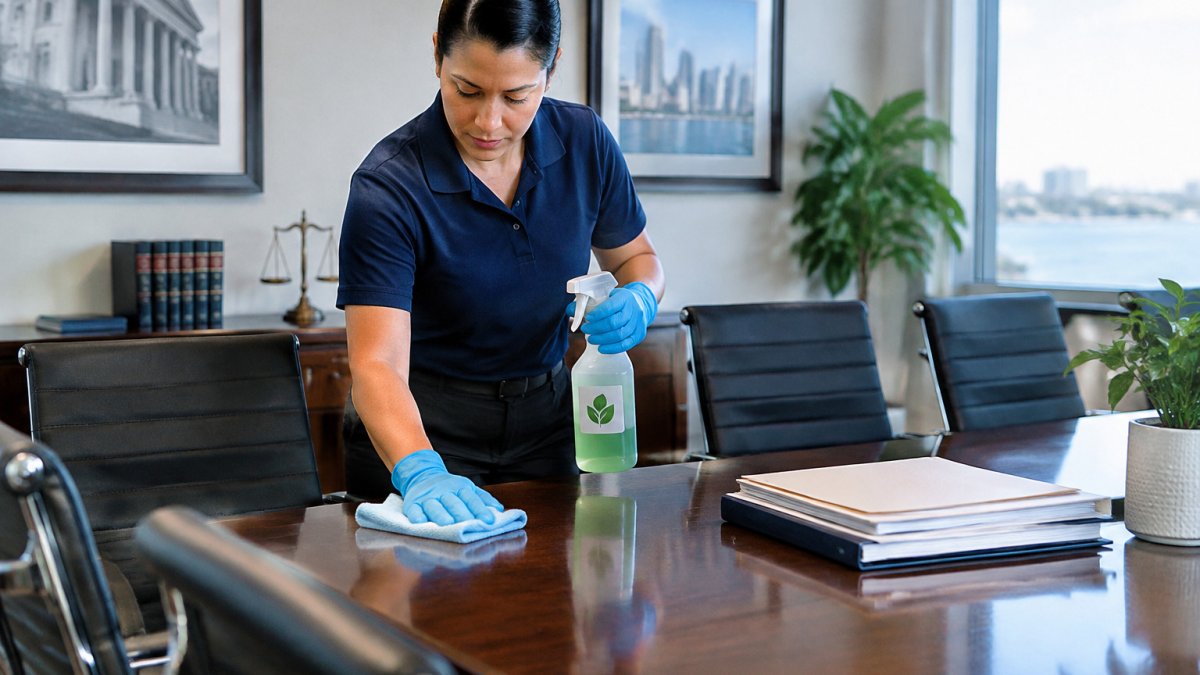
Set a clear-desk expectation for staff, then make sure the crew knows how to handle what they see. Many firms require that crews do not read, move or photograph documents, and that paper is never removed from the building.
Reducing Cleaning Supply Waste and Single-Use Plastics
Waste reduction is where many firms see the fastest savings. Single-use wipes, pre-filled trigger sprayers, paper towels and liner bags add up quickly across a building.
Firms can start with three swaps: concentrated products diluted on site instead of ready-to-use bottles, reusable microfiber in place of disposable wipes, and cloth towel dispensers in place of paper towels where hygiene rules allow.
Paper use also belongs in the plan.
Vetting a Green Janitorial Vendor and Writing the Contract
A green program is only as good as the vendor who runs it. Before you sign, ask for proof rather than promises. The checklist below covers the questions we would want answered in your position:
- Product list with certifications, including certificate numbers
- Safety data sheets available for every product used
- Written, space-by-space cleaning schedule for your building
- Background-checked staff and a named supervisor
- Confidentiality and key-handling terms in writing
- Waste and recycling practices for containers and supplies
- Inspection process and a defined way to report and fix missed work
- Insurance certificate naming your firm
Turn that checklist into procurement requirements, contract clauses and measurable service levels, so the firm can compare bids on the same terms and hold the winner to them.
Procurement questions that separate real programs from marketing.
Contract clauses to require. Put the following in the agreement rather than in a side letter:
- A product schedule attached as an exhibit, with a clause that no product may be substituted without written approval and an updated safety data sheet.
- A confidentiality and key-handling clause: who holds keys or badges, when crews work, how access problems are reported, and a rule that crews do not read, move, photograph or remove documents.
- A service-level section that names response times for complaints and the remedy if a task is missed.
- A reporting clause requiring a monthly summary of product use, waste diverted and disposable supplies avoided.
- An insurance and background-check requirement, with the certificate naming the firm.
- A termination-for-convenience or cure-period clause so the firm can exit if service levels are not met.
Service levels and KPIs to measure. Green cleaning is easier to defend when it is measured. Agree on a small set of indicators at signing and review them monthly:
| KPI | What It Shows | How to Track |
|---|---|---|
| Inspection pass rate | Whether the space-by-task protocol is being followed | Supervisor walkthroughs against the contract exhibit |
| Cleaning-related complaints | Whether changes disrupted daily legal work | A shared log with date, space and resolution |
| Concentrate vs. ready-to-use share | Whether the dilution system is actually in use | Monthly product purchase report |
| Disposable supplies avoided | Progress on waste reduction | Compare orders before and after the switch |
| Waste and recycling volume | Whether containers and supplies are being diverted | Vendor monthly summary |
| Product substitutions | Whether approved products are being used | Compare invoices to the product schedule |
Set targets that fit the building rather than copying another firm's numbers.
Cost, safety and effectiveness trade-offs. Concentrates often cost less per diluted gallon than ready-to-use bottles, but they require training and labeled secondary containers.
Pricing depends on square footage, frequency and scope, so request a written quote for your specific space. You can request a quote from A&S Coastal Cleaning Solutions, LLC through its website.
Rolling Out Your Program and Measuring Results
Even a good plan fails if staff and crews do not follow it. Roll out changes in stages, starting with one floor or practice area before the rest of the building.
Measure what you can see. Track complaints, missed tasks identified in inspections, supply purchases and waste volume over the first three months.
Environmentally conscious cleaning is a series of small, checkable decisions. The firms that keep the program running document it, review it and adjust it rather than setting it once and forgetting it.
Frequently Asked Questions
What are some eco-friendly cleaning practices for law firms?
Law firms can start by switching to cleaning products with recognized third-party certifications, using microfiber cloths and reusable mops instead of disposable wipes, and dosing concentrated products to cut packaging waste. Scheduling cleaning around business hours with a defined plan by space and task reduces unnecessary visits and chemical use. Pairing these steps with paperless workflows and recycling bins in break rooms gives the firm a visible, measurable program that staff can follow consistently.
What makes a cleaning product environmentally friendly?
A product is generally considered environmentally friendly when it has low volatile organic compound (VOC) content, uses biodegradable or renewable ingredients such as citrus or pine oils, and comes in recyclable or concentrated packaging. Look for independent certification rather than vague claims like natural or green on the label. Certifications such as Green Seal evaluate formulas against published criteria, which makes comparison far more reliable than marketing language.
Which cleaning product certifications should a law firm look for?
Green Seal and EPA Safer Choice are two widely recognized programs for commercial cleaning products in the United States. Both evaluate performance, ingredient safety and environmental impact against published standards. Ask your janitorial provider for the specific certification numbers and product data sheets, and confirm they match the products actually brought into your office rather than a similar line.
How can a law firm reduce waste from cleaning supplies?
Start by replacing single-use towels, disposable mop heads and individual wipes with washable microfiber and reusable tools. Buy concentrates and dilute them into labeled refillable bottles, which lowers plastic use and shipping weight. Track supply consumption each quarter so you can see whether the changes are reducing volume, and set a target such as a specific percentage cut in disposable items.
How can law firms improve indoor air quality while cleaning?
Choose low-VOC products, avoid aerosol sprays in occupied spaces, and clean during off-hours or ventilate well afterward. Keep HVAC filters on a regular replacement schedule and use cleaning methods that trap dust, such as HEPA vacuums and damp microfiber, rather than dry sweeping. Staff and visitors notice fewer strong odors and less irritation when these habits are followed consistently.
How should law firms evaluate a commercial cleaning provider's green practices?
Ask for a written list of products with certifications, safety data sheets, and the cleaning methods the provider uses. Confirm the contract specifies product standards, reporting frequency and a process for correcting missed areas. Pricing depends on square footage, service frequency and scope, so request a written quote from A&S Coastal Cleaning Solutions, LLC through its website.
Can environmentally conscious cleaning practices help reduce a law firm's environmental impact?
Yes. Lower-toxicity products reduce chemical discharge, reusable tools cut landfill waste, and efficient scheduling lowers energy and water use. Tracking these changes gives firms concrete figures for sustainability reporting and ESG disclosures, even though the total reduction depends on the firm's starting point and how fully the program is adopted.