 blog
7 RamClean Alternatives for Medical Facilities Compared
Last Updated: November 21, 2026
Quick Summary
The best ramclean alternative for medical facilities is a vendor that documents room-by-room healthcare protocols, uses EPA-registered disinfectants at labeled contact times, and provides inspection records you can audit. Score candidates on protocol depth and quality verification first, since those two criteria most directly affect infection-control risk.
- Weight protocol depth and quality verification double if your facility handles invasive procedures or high patient turnover.
- Small medical practices typically need 3-5 cleaning visits per week, covering exam rooms, restrooms, and waiting areas.
- Ask vendors for sample inspection reports, product safety data sheets, and staff training records before signing.
- A vendor applying one cleaning method to all three risk zones is not matching your compliance needs.
- A&S Coastal Cleaning Solutions is best for practices wanting documented protocols, but skips multi-state national contracts.
Table of Contents
- What Medical Facilities Need From a RamClean Alternative
- Medical Cleaning Service Comparison: How the Top Options Stack Up
- Healthcare Cleaning Vendor Checklist for Evaluating Any Provider
- Hospital Cleaning Techniques That Signal a Qualified Vendor
- Medical Office Cleaning Frequency: What Different Facility Types Require
- Compliance and Infection-Control Requirements for Medical Facilities
- Where A&S Coastal Cleaning Solutions Fits as a RamClean Alternative
- Schedule a Walkthrough and Build Your Facility-Specific Cleaning Plan
- Frequently Asked Questions
What Medical Facilities Need From a RamClean Alternative
Finding a dependable ramclean alternative for medical facilities starts with one question: can the vendor prove what they clean, how they clean it, and when they will show up?
A medical cleaning service is a commercial janitorial program built around healthcare-specific protocols: trained staff, hospital-grade disinfection, documented schedules, and audit-ready records.
Below, we compare ramclean alternatives for medical facilities on service scope, pricing structure, healthcare practices, and transition support.
Medical Cleaning Service Comparison: How the Top Options Stack Up
Most medical offices comparing ramclean alternatives end up with a stack of proposals that use different scopes, different terms, and different definitions of "medical cleaning." The table below applies the same five criteria to each provider category so you can compare like with like. Scores are relative, not absolute: a 5 means the category typically excels at that criterion, a 1 means it usually falls short. Use this as a starting framework, then verify each claim during a walkthrough.
| Provider Category | Healthcare Protocol Depth | Scope Flexibility | Pricing Transparency | Quality Verification | Transition Support |
|---|---|---|---|---|---|
| Regional medical cleaning specialist | 5 | 4 | 4 | 5 | 4 |
| National franchise network | 3 | 3 | 3 | 3 | 3 |
| Hospital environmental services contractor | 5 | 2 | 2 | 5 | 3 |
| Eco-focused commercial cleaner | 3 | 4 | 4 | 3 | 4 |
| Local independent janitorial firm | 2 | 5 | 5 | 2 | 5 |
| In-house crew | 4 | 5 | 3 | 4 | 2 |
| Specialty disinfection vendor | 5 | 1 | 3 | 4 | 2 |
Scope Flexibility
How to Read the Comparison
Scope flexibility measures how easily the vendor adjusts to your mix of clinical, administrative, and common areas.
Pricing transparency measures whether the proposal breaks out frequency, square footage, add-on services, and escalation clauses.
Quality verification measures inspection frequency, documentation, and complaint response commitments.
Transition support measures onboarding, staff access setup, supply responsibility, and continuity planning.
Watch out: a high score in one column does not offset a low score in healthcare protocol depth.
Scoring Your Own Shortlist
Copy the five criteria into a spreadsheet and score each vendor from 1 to 5 after your walkthrough, not after reading the brochure. Weight protocol depth and quality verification double if your facility handles any invasive procedures, wound care, or high-volume patient turnover. A vendor that scores 4 or 5 on those two criteria and 3 or better elsewhere is usually a safer choice than a vendor with a 5 on price and a 2 on protocols. For a deeper walkthrough of the evaluation process, read our guide on how to choose a commercial cleaning service.
Healthcare Cleaning Vendor Checklist for Evaluating Any Provider
Use this checklist to score each ramclean alternative on the same criteria. A provider that cannot answer these questions clearly is a risk to your infection-prevention program.
- Written cleaning protocols for exam rooms, patient areas, and waiting areas
- Named, trained cleaning staff with healthcare-specific instruction
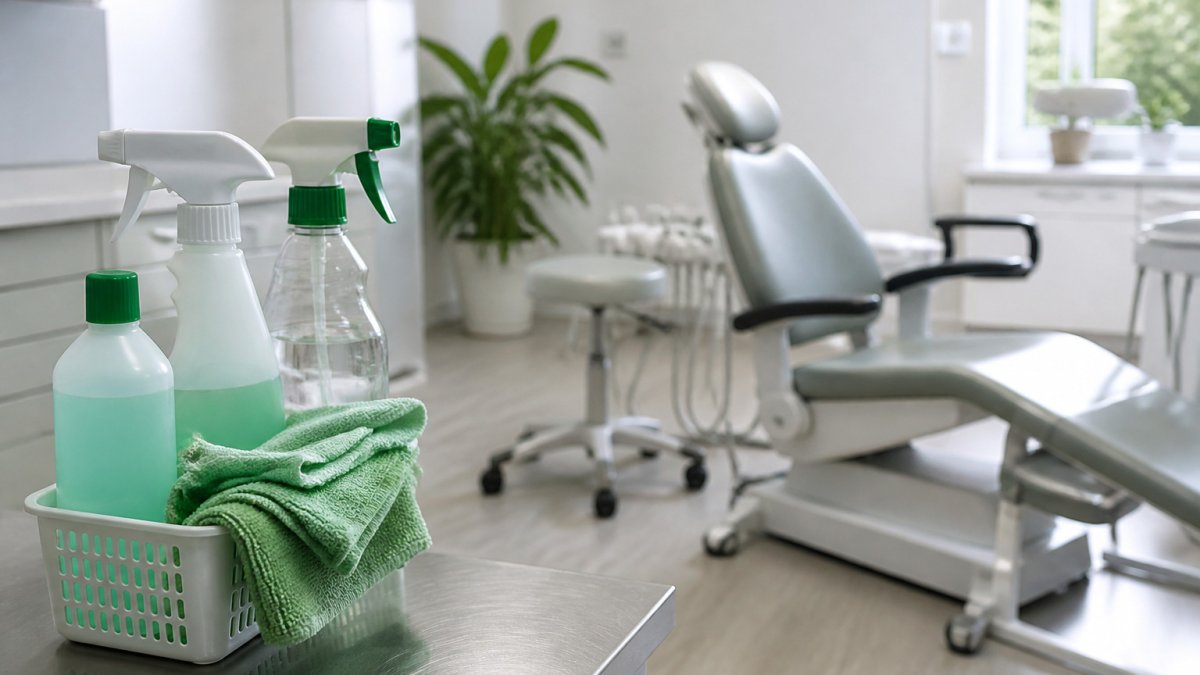
- Product list with EPA-registered disinfectants and dwell times
- Documented cleaning schedule with inspection frequency
- Quality assurance process, including who inspects and how often
- Response time commitment for complaints and missed areas
- After-hours and 24/7 availability terms
- Insurance, bonding, and background checks for on-site staff
- Transition plan that keeps service continuous during the switch
Score each item from one to five. Anything below a three on protocols, disinfection, or quality assurance deserves a follow-up question before you move forward. For a deeper walkthrough of this evaluation, read our guide on how to choose a commercial cleaning service.
Hospital Cleaning Techniques That Signal a Qualified Vendor
Technique separates a healthcare cleaning vendor from a general janitorial crew. Watch for these practices during a walkthrough or reference check.
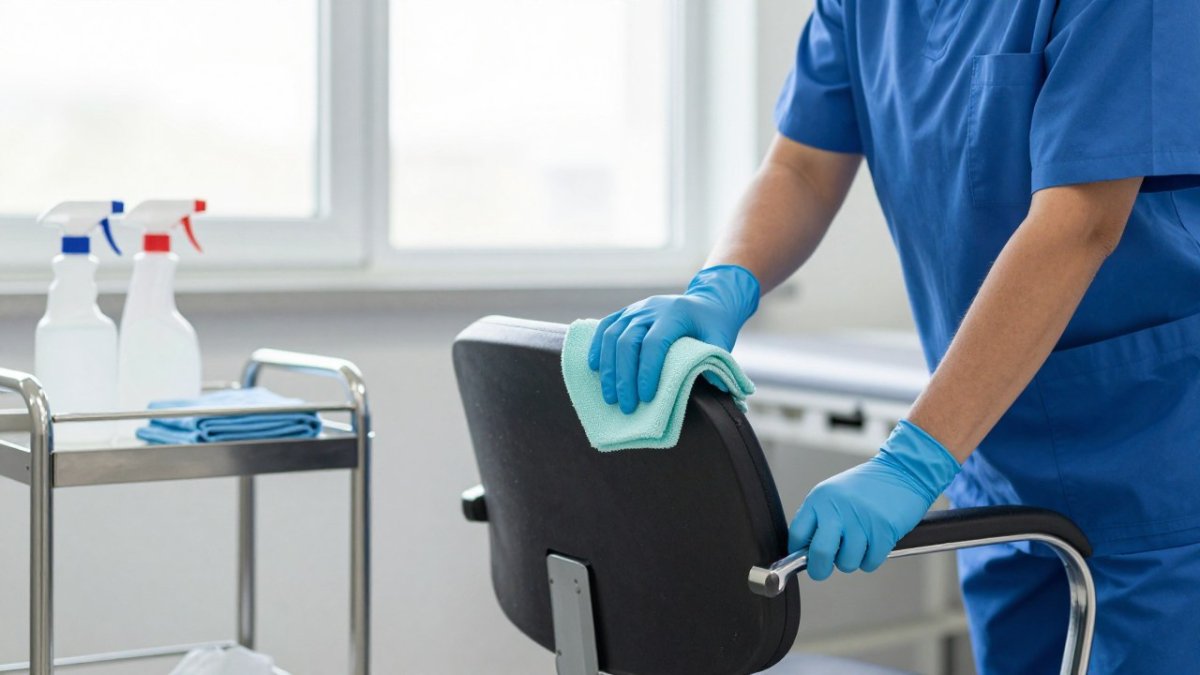
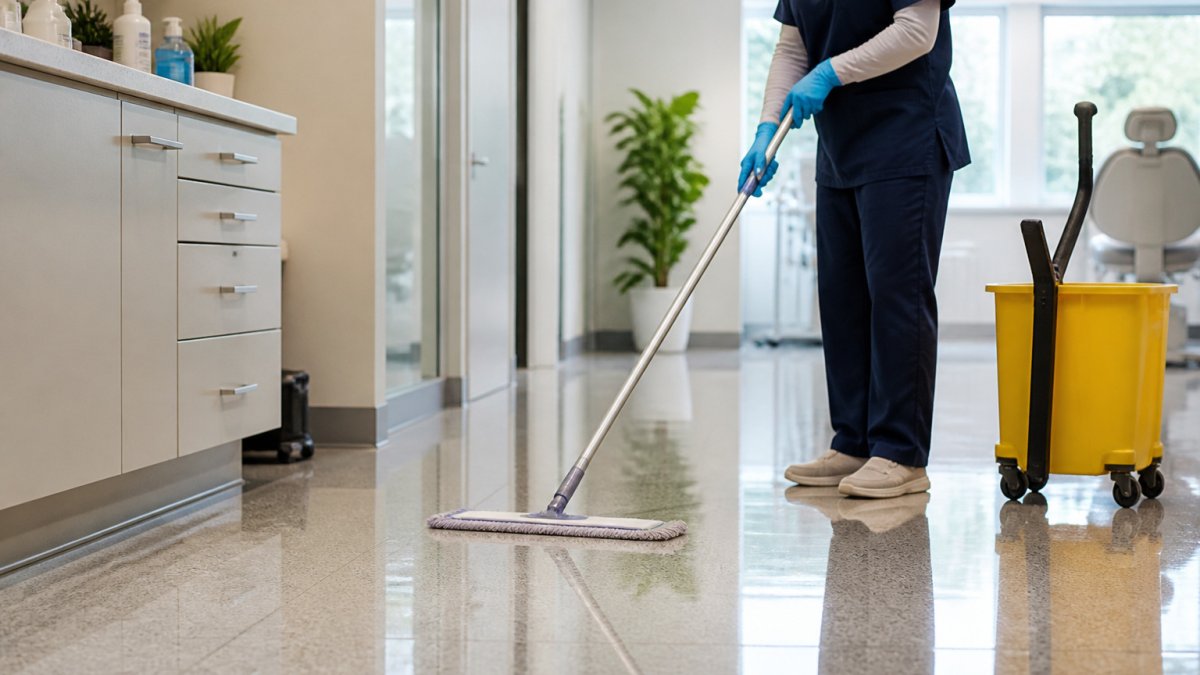
Cleaning and disinfection are treated as two steps, not one. Surfaces get cleaned of soil first, then disinfected with a product that stays wet for its labeled contact time. A crew that sprays and immediately wipes is skipping the step that kills pathogens.
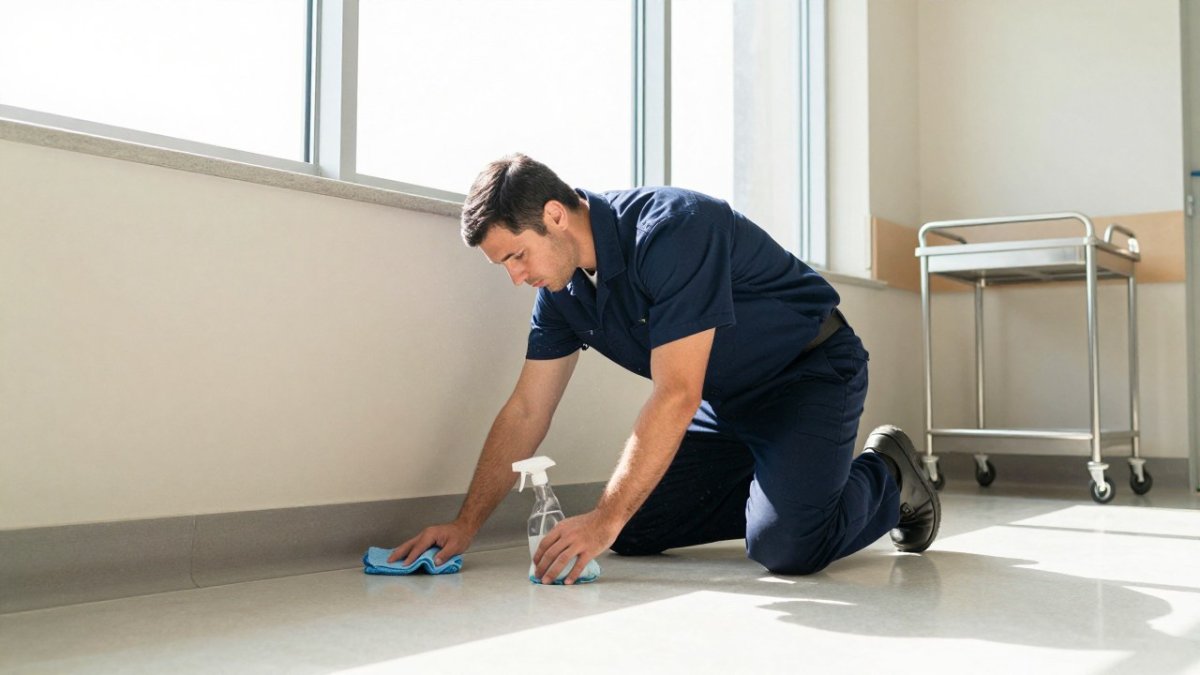
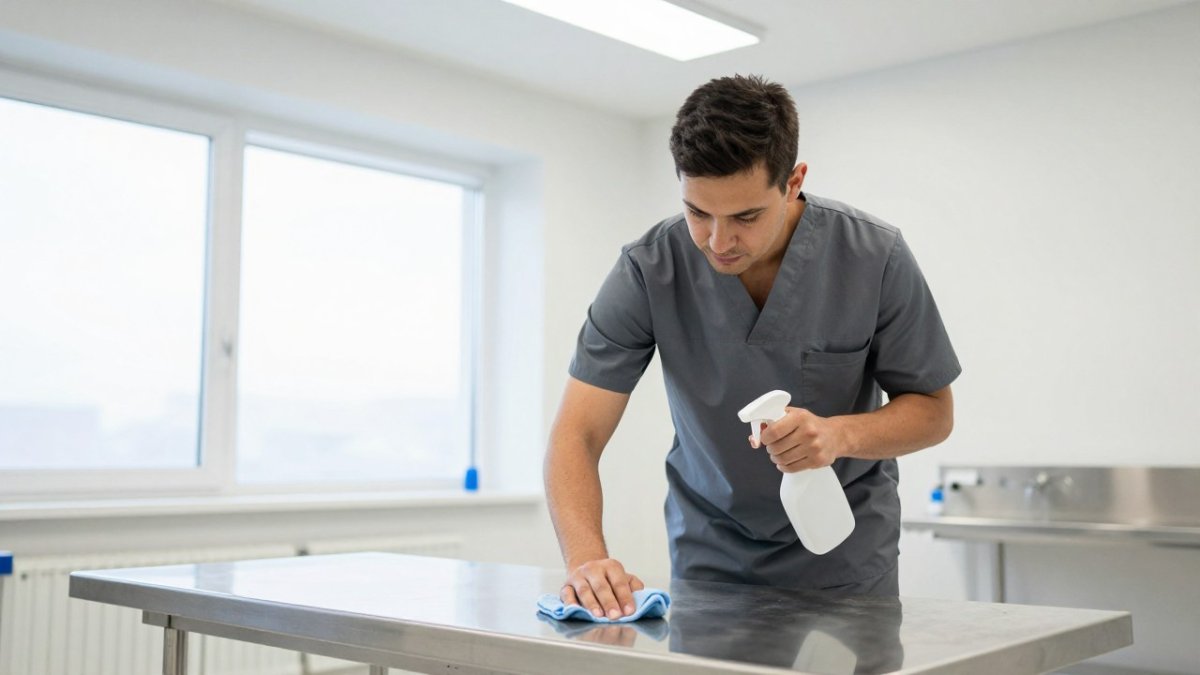
Top-touch surfaces get priority. Door handles, exam table edges, blood pressure cuffs, keyboards, and waiting-room armrests receive documented attention each visit. Vendors who offer structured deep cleaning for inspections, move-ins, or seasonal resets show they understand the difference between routine and recovery work.
Medical Office Cleaning Frequency: What Different Facility Types Require
Medical office cleaning frequency depends on patient volume and the type of care delivered. Here is a practical baseline for common facility types.
| Facility Type | Typical Frequency | Priority Areas |
|---|---|---|
| Small medical practice | 3-5 visits per week | Exam rooms, restrooms, waiting areas |
| Dental or urgent care clinic | Daily, plus mid-day touch-ups | Operatories, high-touch surfaces, reception |
| Multi-provider medical office | Daily | Patient areas, common spaces, break rooms |
| Hospital centers | Continuous or multiple daily shifts | Clinical spaces, isolation rooms, public areas |
| Outpatient surgery center | Daily deep clean, terminal between cases | Procedure rooms, recovery, sterile corridors |
These are starting points, not rules. A clinic with heavy foot traffic may need twice-daily attention on waiting areas and restrooms. A low-volume specialty office may run fine on three visits weekly. The right schedule comes from a walkthrough that counts your actual traffic patterns and risk zones.
Compliance and Infection-Control Requirements for Medical Facilities
Compliance for a medical cleaning vendor is not a single certificate. It is a set of practices, records, and training expectations that vary by facility type and risk zone. The CDC publishes environmental cleaning and disinfection guidance for healthcare facilities that distinguishes between routine cleaning of patient areas and terminal cleaning after a patient with a transmissible infection has occupied a space.
Match Requirements to Your Facility Type and Risk Zones
Not every medical office carries the same compliance burden. A solo primary care practice with exam rooms and a waiting area has different needs than an urgent care center that handles lacerations and potential blood exposure, or an outpatient surgery center with sterile corridors and procedure rooms. Map your facility into three risk zones before you evaluate any vendor:
- High-risk clinical zones: procedure rooms, exam rooms where invasive or wound care occurs, isolation rooms if present, and any area where blood or body fluids are commonly present. These require documented room-by-room procedures, EPA-registered disinfectants used at labeled contact times, and staff trained on bloodborne pathogen precautions.
- Moderate-risk patient zones: general exam rooms, triage areas, reception counters, and waiting-room seating. These require high-touch surface disinfection each visit and color-coded cloths to prevent cross-contamination between restrooms and patient areas.
- Low-risk support zones: administrative offices, break rooms, and storage areas. These can follow standard commercial cleaning protocols but still need documented schedules.
Ask each vendor to describe how their procedures differ across these zones. A vendor that applies one cleaning method to all three is not matching your compliance needs.
Documentation and Records to Request
Compliance is only as good as the paper trail. Before signing, request samples of the records the vendor will keep and make available to you:
- Written cleaning protocols for each risk zone, including which disinfectant is used and its labeled contact time
- Product safety data sheets for every chemical brought on site
- Staff training records showing healthcare-specific instruction, not just general janitorial orientation
- Inspection reports with the date, inspector name, areas checked, and any corrective actions
- Incident or complaint log showing response times and resolution
A vendor that cannot produce these samples during the sales process is unlikely to produce them after the contract starts. Watch out: verbal assurances of "hospital-grade disinfection" without a product list and contact-time documentation are not verifiable and should not satisfy your compliance review.
Staff Training and Separation of Clean and Dirty Processes
OSHA's bloodborne pathogen standard applies to cleaning staff who handle potentially contaminated surfaces, linens, or waste. Ask how the vendor trains staff on PPE use, hand hygiene, and what to do if they encounter sharps or visible blood.
Equally important is the separation of clean and dirty processes. A crew that uses the same cloth on a restroom and an exam table is creating cross-contamination regardless of which disinfectant they use.
What Compliance Does Not Mean
No cleaning vendor can certify your facility as compliant with infection-control standards. Compliance is a shared responsibility between your clinical staff, your policies, and your cleaning vendor's practices. What a vendor can do is provide documented protocols, trained staff, verifiable product choices, and records you can review during your own audits. Evaluate vendors on those concrete deliverables rather than on claims of compliance, and you will have a defensible basis for your selection.
Where A&S Coastal Cleaning Solutions Fits as a RamClean Alternative
We built A&S Coastal Cleaning Solutions around the accountability problem. As a disabled veteran-owned company, we bring military-bred discipline to our work. Medical offices get a facility-specific plan and eco-friendly cleaning solutions.
Our commercial cleaning service covers office, janitorial, floor, and emergency cleaning. We walk your facility before quoting so the scope matches reality.
Best for: medical practices and clinics that want documented protocols, reliable attendance, and a vendor that answers the phone. Skip if: you need a national contract spanning dozens of states under a single corporate agreement.
Schedule a Walkthrough and Build Your Facility-Specific Cleaning Plan
Switching vendors is a decision you should make with your eyes open. Walk your facility with a candidate, point at your busiest exam room, and ask exactly how they would handle it. The answer tells you more than any brochure.
A&S Coastal Cleaning Solutions provides disciplined, eco-friendly commercial cleaning. Review our commercial cleaning pricing to see how cost is based on facility size, service frequency, and scope. You can request a commercial cleaning quote and discuss office or floor care needs with our team.
Your facility deserves a cleaning partner that shows up, documents the work, and answers the phone. Reach out to A&S Coastal Cleaning Solutions to schedule a walkthrough and build a cleaning plan matched to your exam rooms, waiting areas, and clinical spaces.
Frequently Asked Questions
What should medical facilities look for in a cleaning company?
Look for documented cleaning protocols, trained staff with healthcare experience, and a clear quality assurance process. Ask about high-touch surface procedures, after-hours availability, and how the vendor handles infection prevention. Request a healthcare cleaning vendor checklist that covers staff training, equipment, and inspection frequency. A qualified vendor should also carry proper insurance and be able to explain how they protect both patient safety and staff safety in clinical spaces.
How often should a medical office be professionally cleaned?
Medical office cleaning frequency depends on patient volume and facility type. Exam rooms and patient areas typically need daily cleaning and disinfection, while waiting areas and common spaces may require daily or twice-daily attention depending on traffic. Administrative offices within a medical practice often follow a standard commercial cleaning schedule of three to five times per week. High-touch surfaces like door handles, counters, and waiting room chairs should be disinfected at least once daily, and more often during peak season.
What cleaning techniques do hospitals use for infection prevention?
Hospitals rely on a combination of surface cleaning and disinfection using EPA-registered products, with attention to dwell times that ensure disinfection efficacy. Staff follow room-specific protocols: exam rooms get focused high-touch surface treatment, patient areas require more thorough disinfection, and common spaces receive routine cleaning. Many facilities use color-coded microfiber systems to prevent cross-contamination between zones. Trained cleaning staff also follow hand hygiene rules and use specialized equipment like HEPA vacuums to reduce airborne particles in healthcare environments.
How can a healthcare facility assess a cleaning vendor's quality controls?
Ask for the vendor's inspection frequency, response time commitments, and how they document completed work. A strong medical cleaning service comparison should include service-level metrics such as missed-area rates and complaint resolution times. Request sample inspection reports and ask whether supervisors conduct regular walkthroughs. Also confirm the vendor's cleaning schedule includes after-hours service or 24/7 availability for urgent needs, and that they can customize protocols for different risk zones within your facility.